
In the weeks following a devastating family tragedy, Caroline Kennedy has made a deeply personal and life-altering decision — stepping away from the life she once knew to be fully present for the next generation of her family.
According to family members, the 68-year-old daughter of President John F. Kennedy and her husband, Ed Schlossberg, have “upended their lives” after the heartbreaking death of their daughter, Tatiana Schlossberg, who passed away in December 2025 at just 35 years old following a battle with acute myeloid leukemia.
What followed was not a public statement or a ceremonial appearance — but a quiet relocation, a change of rhythm, and a new reality built entirely around family, grief, and care.
Tatiana, a respected journalist and writer, had been married to Dr. George Moran since 2017. Together they shared two young children — Edwin, 4, and Josephine, 2 — who have now become the center of Caroline Kennedy’s world in the most unexpected and emotional way.:max_bytes(150000):strip_icc():focal(749x0:751x2)/Jack-Schlossberg-Caroline-Kennedy-John-F.-Kennedy-Profile-in-Courage-Award-Ceremony-060926-6b6d6c9e1a6e44c9b6bde6414d6bf4c1.jpg)
Her brother, Jack Schlossberg, confirmed the shift in an interview with People, describing how their parents have effectively stepped into a new role no one could have imagined.
“They’re playing the role of new parents right now,” he said. “They moved in with my sister’s husband and the kids. They’re really taking care of them every single day.”
He added that most people don’t fully understand the reality of what is happening behind closed doors — that Caroline Kennedy and Ed Schlossberg are not just visiting family, but living alongside their late daughter’s household, helping to raise her children day by day.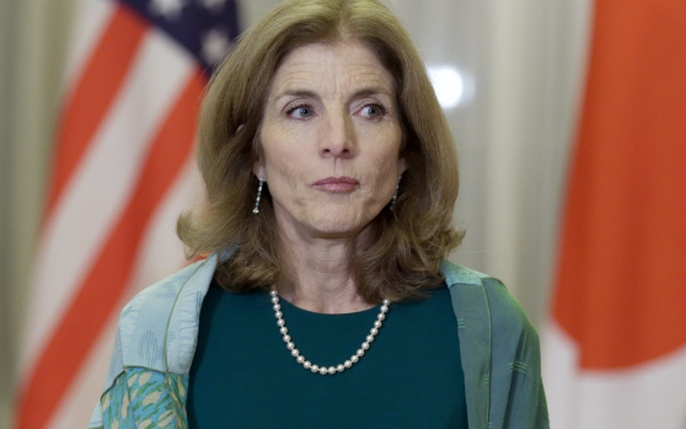
“They’re all living in the same apartment,” Jack explained. “They’re really taking everything in stride, but they’re really taking care of the kids.”
It is a transformation that speaks quietly, but powerfully, of a family reshaped by loss.
Tatiana’s death in December 2025 sent shockwaves through both political and literary circles. In a deeply personal essay published in The New Yorker, she revealed her diagnosis — acute myeloid leukemia — which she first received in May 2024. Doctors had given her a prognosis of just one year.
In her own words, she described the disbelief that followed the diagnosis, writing that she “did not — could not — believe” they were talking about her. At the time, she was newly a mother, still adjusting to life with a young child and another pregnancy behind her.
Her reflections were both heartbreaking and intimate, capturing the painful collision between motherhood and mortality. She wrote candidly about her children, acknowledging that her son might one day only remember fragments — images, stories, pieces of a life that would become increasingly distant.
For her daughter, she admitted something even more painful: uncertainty about whether she would remember her at all.
In those same writings, Tatiana praised her husband for his unwavering support during treatment, describing how he managed hospital logistics, spoke to doctors, and stayed by her side through long nights of uncertainty.
“My son might have a few memories,” she wrote, “but he’ll probably start confusing them with pictures he sees or stories he hears.”
Following her passing, the family announced the news through the JFK Library Foundation, signing the message with a collective of names that reflected a tightly bound family circle — George, Edwin, Josephine, Ed, Caroline, Jack, Rose, and Rory.
Now, that circle has narrowed into something even more intimate.
According to Jack Schlossberg, the children are not only being cared for — they are being raised in a shared home environment where grandparents have stepped into daily parental responsibilities.
“They make me laugh my head off just like she did,” Jack said of his niece and nephew, offering a glimpse of how Tatiana’s presence continues through her children.
The emotional weight of the situation was also reflected in Caroline Kennedy’s first public remarks following her daughter’s death. Speaking at the John F. Kennedy Profile in Courage Award ceremony in May 2026, she fought back tears as she addressed Tatiana’s legacy.
“We remember Tatiana, who served on the board of this library and represented everything my parents stood for in her beautiful, amazing and too-short life,” she said.
It was a rare moment of public vulnerability for a figure long known for her composure and privacy.
Now, that grief has quietly transformed into action — not through speeches or appearances, but through presence.
Caroline Kennedy and Ed Schlossberg are not simply mourning a daughter. They are raising her children.
And in doing so, they are preserving something far more fragile than public legacy — the continuity of a family shaped by love, loss, and responsibility carried forward in the most personal way possible.
What remains is not just sorrow, but devotion — a quiet decision to rebuild life not around what was lost, but around those who remain.


