
For decades, Fiona Phillips was known to millions as the warm, familiar face who helped Britain wake up each morning.
Confident, quick-witted and instantly recognisable from her years on television, she built a career around conversation, connection and remembering the stories of other people.
Today, however, life looks profoundly different.
Away from the television studios and public appearances that once defined so much of her working life, Fiona is living through an intensely personal battle with Alzheimer’s disease — while her husband, former television executive Martin Frizell, has found himself confronting a reality no partner ever wants to face.
He is watching the woman with whom he built a marriage, raised a family and shared decades of memories gradually lose access to parts of the life they created together.
And perhaps the most painful part is that there is no single moment when everything changes.
Instead, there are small losses.
A forgotten celebration.
A recent conversation that disappears.
A familiar event that no longer carries the memory it once did.
Little by little, the landscape of everyday life shifts.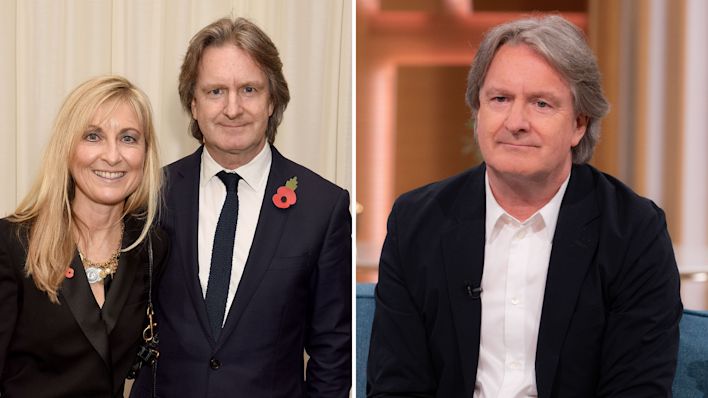
Martin has now spoken movingly about that experience, describing the devastating sense that Fiona is gradually moving further away from the person she once was.
“We can see her slipping away,” he admitted.
It is a short sentence.
But behind those few words lies the enormous emotional weight of a family learning how to love someone through a disease that can slowly alter memory, independence and identity.
The diagnosis that changed everything
Fiona publicly revealed her Alzheimer’s diagnosis in 2023.
She was only in her early sixties when she received the news.
Before doctors identified the condition, some of the changes she was experiencing had initially seemed as though they might be connected to menopause.
There was confusion.
Anxiety.
Brain fog.
Symptoms that, taken individually, could easily be explained away as part of something far less frightening.
But eventually came the diagnosis that Fiona and her family had every reason to dread.
Alzheimer’s.
For Fiona, the disease already carried a deeply personal significance.
Both of her parents had experienced Alzheimer’s, meaning she understood all too well what the diagnosis could potentially mean.
Knowing the disease from the outside, however, could never fully prepare her for becoming the person living with it.
Nor could it prepare Martin for becoming the person standing beside her.
Their lives changed.
Priorities changed.
And the future they may once have imagined together suddenly became much more uncertain.
From television executive to full-time carer
For years, Martin had lived inside the demanding world of British television.
As a senior figure behind the scenes, including his time as editor of This Morning, his professional life revolved around deadlines, live broadcasts and the relentless pace of daytime television.
Eventually, another responsibility became more important than any television programme.
Fiona.
Martin stepped away from his career and became increasingly devoted to caring for his wife.
It was not simply a professional decision.
It represented an extraordinary transformation in their marriage.
The person who had once been his partner in the ordinary rhythm of family life now needed growing levels of support.
Their relationship was still a marriage.
But it was also becoming something else.
Martin was becoming a carer.
And that role carries a kind of emotional complexity that is difficult to understand unless you have lived it.
There are practical responsibilities: appointments, medication, routines and constant decisions.
But there is also something much harder to measure.
Grief.
Not necessarily grief for someone who has died, but grief for pieces of a shared life that may gradually become inaccessible to the person you love.
Martin has described the experience with painful simplicity.
“It’s wretched,” he said.
Few words could capture it more clearly.
When shared memories become one person’s memories
A marriage lasting decades is built from thousands of moments.
Some are enormous.
Weddings.
Birthdays.
The arrival of children.
Career milestones.
Christmas mornings.
Family holidays.
Others are so ordinary that nobody thinks to treasure them at the time.
A joke at breakfast.
A familiar argument.
A favourite restaurant.
A phrase only the two of you understand.
A look across a crowded room.
Together, those memories form the private history of a relationship.
Alzheimer’s can begin changing that history in a particularly cruel way.
Martin has revealed that Fiona can no longer recall some relatively recent events, including Christmas and New Year.
For many families, those celebrations become markers in time.
Photographs are taken.
Meals are shared.
Stories are repeated.
Everyone assumes the memories will remain.
But for someone living with Alzheimer’s, yesterday can sometimes become harder to reach than something that happened decades earlier.
That creates an extraordinary emotional imbalance for the person standing beside them.
Martin may remember a moment perfectly.
He may remember what Fiona wore, what she said or how she laughed.
But Fiona may no longer be able to travel back to that same memory with him.
A shared memory can slowly become a memory carried by only one person.
That may be one of the quietest heartbreaks of dementia.
But Fiona is still Fiona
There is something Martin desperately wants people to understand.
Memory loss does not mean the person has simply disappeared.
“I don’t want people to think she’s gone,” he has explained.
“She’s still very much with us.”
That distinction matters deeply.
Because Alzheimer’s can sometimes cause outsiders to speak about a person entirely in terms of what they have lost.
What they can no longer remember.
What they can no longer do.
What has changed.
But families often continue to recognise flashes — sometimes powerful ones — of the person they have always known.
A familiar expression.
A sense of humour.
A stubborn streak.
A smile.
A reaction that is unmistakably them.
Martin has even joked that Fiona remains “the world’s most stubborn woman”.
Medication, apparently, can still become a battle of wills.
There is something wonderfully human about that detail.
Because for a moment, the disease is not the centre of the story.
Fiona is.
The same personality that her family has known for years can still emerge in everyday moments.
And those moments have become enormously precious.
A photograph that told another side of the story
Martin has also shared glimpses of Fiona enjoying time with her family.
To outsiders, a simple photograph of someone smiling may seem unremarkable.
For families living with dementia, however, ordinary happiness can carry extraordinary meaning.
A good afternoon matters.
A laugh matters.
A moment of recognition matters.
A peaceful walk or family outing matters.
Because life with Alzheimer’s is not necessarily a continuous sequence of sadness.
There can still be humour.
Affection.
Comfort.
Connection.
There can still be moments in which the disease seems temporarily pushed into the background and the person everyone loves comes unmistakably to the foreground.
These moments may not change the diagnosis.
But they change the day.
And sometimes, when the future feels impossible to control, a good day is enough.
The hidden toll on the entire family
Dementia is diagnosed in one person.
Its consequences, however, spread far beyond them.
Martin has spoken about Alzheimer’s as something that affects an entire family.
Fiona and Martin have two sons, who have also had to adjust to watching their mother change.
For children — even adult children — that experience can be extraordinarily difficult.
Parents often represent continuity.
They are the keepers of childhood stories.
They remember first days at school, embarrassing moments, family traditions and tiny details their children themselves may have forgotten.
When a parent begins losing memories, the emotional roles within a family can slowly shift.
Children may find themselves helping to care for the person who once cared for them.
A spouse may become responsible for decisions that were once made together.
Every member of the family has to adapt.
And they may all be grieving something slightly different.
For Martin, there is also the relentless responsibility of being the person closest to Fiona’s day-to-day reality.
Caring does not stop when someone is tired.
It does not respect weekends.
There is no end-of-shift moment when a spouse can simply leave the emotional weight behind.
Love and responsibility exist in the same room, every day.
Speaking publicly about what many families endure privately
Fiona and Martin could have chosen to keep much of this experience behind closed doors.
Instead, they have spoken publicly about the realities of Alzheimer’s.
Their decision has helped bring attention to an experience shared by countless families who rarely see the full complexity of dementia represented publicly.
Their memoir, Remember When: My Life With Alzheimer’s, offers an intimate perspective on Fiona’s diagnosis and Martin’s experience of caring for her.
It is not simply a story about memory loss.
It is about what happens to a marriage when one partner becomes seriously ill.
It is about fear.
Frustration.
Exhaustion.
Uncertainty.
And the strange coexistence of grief and gratitude.
Because families affected by dementia often live with two truths at once.
They can mourn what is changing while still being deeply thankful for what remains.
Martin has also used his voice to call for greater investment in dementia research and stronger support for those caring for loved ones.
Behind every diagnosis is often an invisible network of people doing everything they can to keep life functioning.
Partners.
Children.
Friends.
Carers.
People quietly reorganising their entire existence around someone they love.
A marriage entering a chapter neither of them chose
Perhaps the most moving part of Fiona and Martin’s story is not simply what Alzheimer’s has taken.
It is what remains.
Their marriage is no longer the same marriage they once knew.
How could it be?
Illness changes relationships.
Roles shift.
Plans disappear.
The future becomes harder to imagine.
But love does not depend entirely on memory.
Martin can remember for both of them.
He can hold the stories Fiona may struggle to retrieve.
He can remember the television years.
The family milestones.
The Christmases.
The arguments.
The laughter.
The ordinary days nobody realised would one day become precious.
And when Fiona cannot remember a moment, that does not mean the moment never existed.
It still lives in the people who shared it with her.
Holding tightly to the person who remains
There is no easy ending to a story about Alzheimer’s.
No perfect sentence can remove the fear of what may come next.
Martin’s admission that the family can see Fiona “slipping away” is devastating precisely because it acknowledges something many carers quietly experience: the feeling of losing parts of someone while still being able to sit beside them, hold their hand and hear their voice.
Yet his other message may be equally important.
Fiona is still here.
She can still smile.
She can still be stubborn.
She can still share moments with the people who love her.
And those moments matter.
Perhaps more than ever.
For a family living with Alzheimer’s, love becomes less about assuming there will always be another Christmas, another holiday or another remembered conversation.
It becomes about recognising the value of what exists today.
A smile.
A familiar expression.
A quiet afternoon together.
The person sitting beside you.
Alzheimer’s may change the way memories are held.
It may erase details that once seemed impossible to forget.
But Fiona Phillips’ story is also a reminder that a human life is far greater than the memories a disease can take away.
And as Martin continues walking beside the woman he has loved for decades, he is carrying something Alzheimer’s cannot simply erase:
the history they built together — and the love that remains even when remembering becomes harder.


